Showing posts with label steel channel strut. Show all posts

Monday, March 23, 2020

Strut Channels and Fittings Parts


A strut is a structural issue that is normally utilized in architectural and creates jobs for resisting any sort of longitudinal compression. Struts provide outward-facing support to the shape in the course in their duration and may be used for preserving two different additives separate from every other, thereby appearing an opposite characteristic of ties.

Engineering and architectural industries are quite acquainted with this period and use it on a normal basis. Struts are crafted from fiber-bolstered plastic, metal, or aluminum and are usually utilized in constructing constructions. They are frequently furnished with aid through cables and other kinds of assistance systems. Struts are also used in piping for holding the movement of an underlined element in one direction, whilst permitting the component to contract or move inside the other course.

Struts also have extremely good software value in the wood framing industry, where they regularly come in handy for supporting or bracing the lighter scantlings easily as compared to posts. They can be often located installed within the roof frames on the tie beam or from the king publish straight to the main rafter. As struts are of no need on their own, they are utilized in mixture with the strut channels and fittings.

Channels

Strut channels are the material this is used to provide structural support to wires, piping and any other form of related device in buildings. These channels are particularly used for air conditioning, warmth ventilation, or HVAC packages for postponing the gadget from the roof or ceiling.

Standard strut channels include a long steel sheet, bent and folded for developing a U-Shaped stiff channel. Its edges are turned interior and face towards others, thereby growing a groove over the top of the equipment. This enables the installers to interlock the additives collectively or fit them using nut bolts and fasteners into the channel.


Fittings

The fitting of struts and channels isn't always possible without the use of extra strut fittings and accessories. The strut makers produce a wide range of fittings to finish the strut system and to make the structural assist even stronger. Some of the maximum widely frequent fittings consist of angle fittings, beam clamps, channel brackets, braces, strut cease caps, hangers, electrical accessories, pipe clamps, strut trolleys, put up bases and pipe straps.

Materials

The strut channels and fittings are manufactured in a wide kind of shapes, sizes, and finishes. However, the distinction in shapes, sizes, and finishes isn’t sufficient for making the struts in shape the needs and requirements of the different forms of installations. Thus, many manufacturers use different varieties of materials to make struts strong sufficient for different sorts of packages.

Struts are usually manufactured from chrome steel to dispose of the probabilities of rust or fiberglass, for protection against corrosive environmental factors. However, wherein the load of the struts is a number one issue, manufacturers make use of aluminum alloy for making struts. steel channel strut

In day-to-day construction or architectural jobs, installers opt to use stainless steel struts. They are crafted from a protracted sheet of metallic and often come galvanized with a zinc coating, epoxy, powder coating, paint or any other type of finish. The zinc coating protects the stainless-steel from rust, corrosion and other sorts of outside elements, thereby imparting it an extended and sturdy life.

No count what type of device calls for an aid machine inside the building, strut channels, and fittings find an area in architecture and creation jobs. All it takes is the precise selection of strut channels and right fittings to present that structure organization support and permit it to face in its role for a miles longer duration.

Saturday, March 21, 2020

How Does Altitude Affect AC-DC Power Supplies?

Most AC-DC power materials that meet the protection standards in step with UL/EN 60950-1 for ITE (Information Technology Equipment) applications are designed to perform at the typical workplace and factory altitudes, that may vary from barely above sea degree to as high as 2,000 meters (6,562 feet). And, many energies deliver producers provide gadgets that are designed and rated for operation at higher altitudes, as much as 3,000 meters (9,843 feet) so their resources may be used in fundamental cities positioned at better elevations (e.G., Denver, Santa Fe, Mexico City, Bogota). Many broadcasting/communications stations/towers are placed at altitudes up to 3,000 meters or higher so that you can maximize their range.

Altitude affects the layout of power supplies in view that ‘air’ is used as an electric-powered insulating medium (aka, dielectric) inside the production of energy materials, as nicely as maximum electronic devices. The density and dielectric strength (insulating property) of air is superb at sea level, but at higher altitudes, the thinner air loses some of its dielectric strength, which wishes to be compensated for. Switchmode strength components function off of high voltages (inputs of 90 to 265Vac) and internally generate even higher voltages (400Vdc or more), which want to be insulated and contained to prevent excessive voltage arcing or breakdown in the delivery, and to defend the end-system and working personnel. power strut vs unistrut

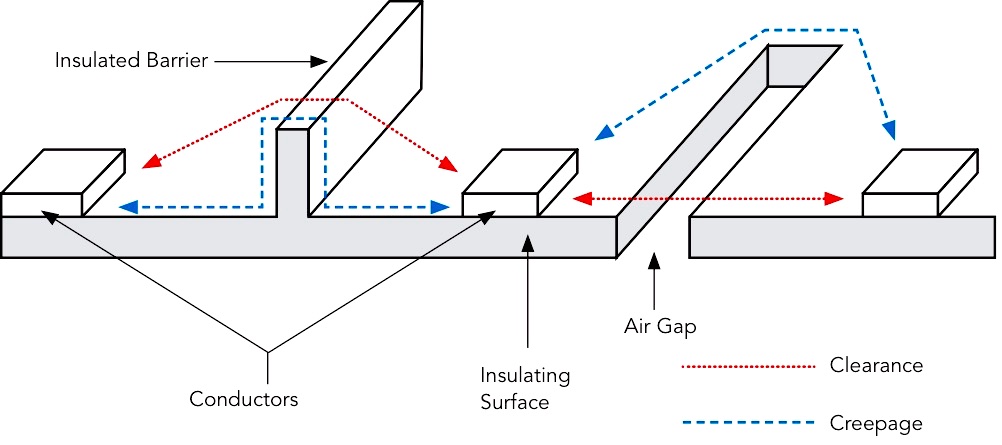
The drawing under shows a cross-phase of a typical revealed circuit board (PCB), which is constructed from copper electric conduction paths that our chemically etched on an insulated (dielectric) fiberboard material (e.G., FR4, woven fiberglass fabric with epoxy resin), plus electronic additives that aren't shown on this drawing. As can be seen, the fiberboard and air, mixed with the distances among the etched conductive traces are the primary insulation mediums for the circuit board.

The term ‘Clearance’ refers to a shortage path between the two conductive components (circuit lines, components, etc.), measured via air.
The term ‘Creepage’ refers back to the shortage path among conductive elements measured alongside the floor of the insulation (PCB, insulating materials/barriers, etc.).

What does this ought to do with altitude? Since ‘air’ gets thinner (reduced barometric pressure) at better altitudes and turns into less of an insulator, the PCB and issue layouts must be designed with enough protection spacing distances to save you high voltage arcs or breakdowns between conductors and/or digital additives. ps 200 eh 10 pgal

For example, typical electricity delivers design exercise that may permit an eight mm spacing distance between number one and secondary circuits and four mm spacing distance between primary and ground. These spacing distances will range relying upon the voltage ranges between conductors and components and the predicted humidity, temperatures, pollution tiers, and attitudes.

For that energy merchandise that should be approved according to the Chinese CCC organization (required to export substances into China), the new Chinese Safety Standard GB 4943.1-2011, which is just like UL/EN 60950, ps 1100 requires strict specifications for creepage and clearance distances. As of December 1, 2012, the number one-to-secondary clearances ought to grow via an issue of 1.48 to qualify the supply for operation up to 5,000 meters, considering many areas in China are located at high altitudes. The opportunity for CCC certified electricity supplies is that they have to marked with a warning label that states that the strength deliver should be used beneath 2,000 meters

The other principal impact of high altitudes on strength materials is that the much less dense air does now not conduct warmth as nicely. To compensate for better altitudes, electricity resources need to be derated, or employ large heat sinks, or have increased compelled airflow, or a combination of those to ensure proper cooling. Also, the electricity delivery needs to be designed with the proper conductor and component clearances as discussed above.

In summary, whenever an application requires that a power supply should perform at altitudes above 2,000 meters (6,562 feet), always take a look at with the manufacturer to decide if that is acceptable, or if a change model is designed for higher altitudes is required.